Supersets vs. Traditional Sets: Which One Actually Builds More Muscle?
Supersets can save serious time in the gym—but do they build as much muscle as traditional sets? We break down the science behind both training styles and show you how to use each one to maximize muscle growth without wasting time.

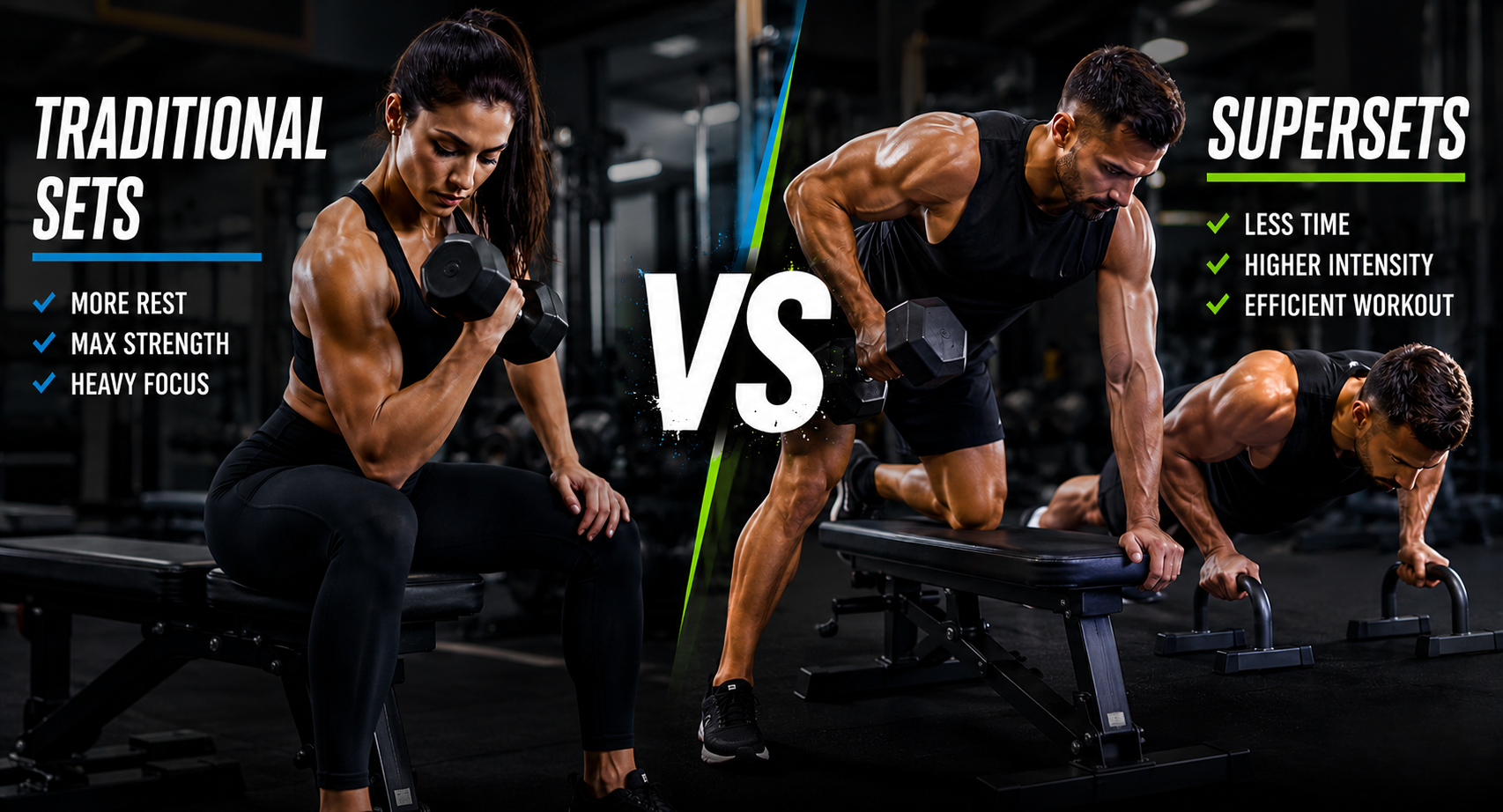
Can you really cut your workout time almost in half and still build muscle? Supersets promise a faster, more intense workout, while traditional sets give you more time to recover and lift heavy. But when muscle growth is the goal, the science suggests the difference may be much smaller than you think.
The Gym Debate: Do Supersets Really Work?
If you’ve spent enough time in the gym, you’ve probably seen both approaches. One person completes a set, rests for a couple of minutes, repeats it, and eventually moves on to the next exercise. Another finishes a set and immediately moves into a second exercise before taking a break. The first is using traditional sets. The second is using supersets.
Supersets have become especially popular because they can make a workout significantly shorter. But there is still a common concern:
If you rest less, are you sacrificing muscle growth?
Not necessarily.
A growing body of research suggests that properly programmed supersets can produce similar muscle growth to traditional resistance training while requiring considerably less time.
The key word, however, is properly.
First, What Exactly Is a Superset?
A traditional resistance-training structure normally looks something like this:
- Exercise A → Rest → Exercise A → Rest → Exercise A
A superset pairs two exercises:
- Exercise A → Exercise B → Rest → Repeat
Instead of resting immediately after the first exercise, you perform another exercise before taking your recovery period. But not every superset creates the same training effect.
You could pair opposing muscle groups:
- Chest Press + Row
You could alternate different areas of the body:
- Romanian Deadlift + Shoulder Press
Or you could train similar muscles back-to-back:
- Chest Press + Push-Ups
All three technically reduce downtime, but the fatigue they create—and how that fatigue affects your next set—can be very different.
So, Which One Builds More Muscle?
A 2025 systematic review and meta-analysis published in Sports Medicine compared supersets with traditional resistance training. The researchers analyzed 19 studies involving 313 participants and examined both immediate training responses and long-term adaptations.
The result?
For muscle hypertrophy, there was no significant difference between supersets and traditional sets. The analysis also found similar long-term improvements in maximal strength and muscular endurance overall. But supersets accomplished something traditional training couldn't: They got similar training work done in less time.
That makes supersets particularly interesting for the person who says:
"I want to build muscle, but I don't have 90 minutes to spend at the gym."
There is, however, an important limitation worth understanding. Only a small portion of the studies included in the review directly examined long-term hypertrophy. So while the current evidence is encouraging, we shouldn't interpret it as proof that every possible superset program will produce exactly the same results as every traditional program.
The better conclusion is:
- Current evidence does not show a meaningful hypertrophy advantage for traditional sets over well-designed supersets.
Where Supersets Really Win: TIME
In the 2025 analysis, supersets allowed participants to perform a similar number of repetitions and overall volume load while substantially improving training efficiency.
A separate 2024 randomized controlled trial provides an excellent real-world example. Participants performed either traditional sets or supersets during a whole-body resistance-training program that included:
- Leg press
- Bench press
- Lat pulldown
- Seated row
They trained twice per week for 10 weeks. The researchers reported that the superset structure nearly halved the duration of the training sessions. Both groups increased muscle mass, and changes in body composition were similar between groups. That means you don't necessarily need to spend more time in the gym to get more out of your training.
But There's a Catch: Supersets Feel Harder
Less rest doesn't magically eliminate fatigue.
The 2025 meta-analysis found that supersets produced higher:
- Blood lactate levels
- Energy expenditure during training
- Ratings of perceived exertion
In simple terms? The workout can feel harder even if it is shorter.
That isn't automatically a bad thing. But feeling exhausted should never be confused with having a better muscle-building workout. Sweating more, breathing harder, or feeling a massive "burn" doesn't automatically mean you're stimulating more hypertrophy.
For muscle growth, we still need quality resistance training. And if your superset makes you so tired that your load, repetitions, range of motion, or technique fall apart, the time-saving benefit may come at a cost.
Traditional Sets Still Have an Advantage
This is especially true when strength and performance become priorities.
In that same 2024 randomized trial, traditional training produced greater improvements in the lat pulldown and showed a tendency toward greater improvement in the seated row. Bench press and leg press strength improvements, however, were similar between groups. So although muscle-mass changes were comparable, performing multiple heavy compound exercises as supersets may interfere somewhat with maximal strength development.
That makes sense.
If I want you performing your strongest possible squat, deadlift, hip thrust, bench press, or another major lift, I probably don't want you entering the set already exhausted from another demanding exercise.
Traditional sets give you something extremely valuable: Recovery.
And sometimes recovery is exactly what allows you to train harder.
Research examining rest periods also supports giving yourself enough recovery. A 2024 systematic review and meta-analysis found evidence of a small hypertrophy benefit from resting longer than 60 seconds, likely because longer recovery can help maintain training performance and volume. Interestingly, the researchers didn't find appreciable additional hypertrophy benefits once rest periods exceeded roughly 90 seconds.
So rest isn't wasted time.
Sometimes it's what makes the next productive set possible.
This Is Why I Wouldn't Choose Just One
Here's where practical programming matters more than picking a "winner."
Your entire workout doesn't have to be traditional sets.
And your entire workout doesn't have to be supersets.
You can use both.
For example:
A. Hip Thrust
4 sets × 6–8 reps
Performed alone with adequate rest
Then:
B1. Bulgarian Split Squat
3 sets × 8–10 reps
B2. Leg Curl
3 sets × 10–12 reps
Performed as a superset
Then:
C1. Cable Abduction
3 sets × 12–15 reps
C2. Calf Raise
3 sets × 12–15 reps
Performed as a superset
Now you're protecting the performance of your major lift while using supersets to make the rest of the workout more efficient.
You don't have to choose between quality and efficiency.
Program for both.
What Actually Matters More for Muscle Growth?
This is the part that tends to get lost when we debate training methods. Your muscles don't know whether your workout spreadsheet says "Superset" or "Traditional Set."
Muscle growth respond to the training stimulus you create. Research continues to show that variables such as training volume and effort are important for hypertrophy. Higher weekly resistance-training volume generally produces greater muscle growth, although more isn't endlessly better. And recent research examining proximity to failure suggests that muscle hypertrophy tends to increase as sets are performed closer to failure. That doesn't mean every set needs to end with you physically unable to complete another repetition. It means your working sets actually need to be challenging.
So, Should You Use Supersets?
If your goal is primarily building muscle, absolutely—you can.
They may be particularly useful if:
- You have limited time to train.
- You enjoy faster-paced workouts.
- You want to increase workout density.
- You struggle to finish longer training sessions.
- You're performing accessory exercises that don't require maximal strength.
- You can pair exercises without one significantly interfering with the other.
Traditional sets may make more sense when:
- You're performing a heavy compound movement.
- Maximizing strength is a major goal.
- Technique requires significant concentration.
- Your next exercise uses the same heavily fatigued muscles.
- The superset noticeably reduces your repetitions or load.
And for many people?
- A combination of both is probably the most practical approach.
The Upshot
You don't need to spend two hours in the gym to build muscle.
And you don't need to turn every workout into a nonstop circuit either.
The current research suggests that supersets can produce muscle growth comparable to traditional resistance training while making workouts considerably more time-efficient.
But how you design those supersets matters.
If maximizing performance on a heavy lift is the priority, give yourself the recovery you need.
Then use intelligently selected supersets for the rest of your workout.
Because when it comes to building muscle, the question isn't simply:
"Are supersets better?"
A better question is:
"Can I use supersets to make my training more efficient without sacrificing the quality of my work?"
And according to the current evidence, the answer is yes.
References
- Zhang X, Weakley J, Li H, Li Z, García-Ramos A. (2025). Superset Versus Traditional Resistance Training Prescriptions: A Systematic Review and Meta-analysis Exploring Acute and Chronic Effects on Mechanical, Metabolic, and Perceptual Variables. Sports Medicine, 55(4), 953–975.
- Iversen VM, Eide VB, Unhjem BJ, Fimland MS. (2024). Efficacy of Supersets Versus Traditional Sets in Whole-Body Multiple-Joint Resistance Training: A Randomized Controlled Trial. Journal of Strength and Conditioning Research, 38(8), 1372–1378.
- Singer A, Wolf M, Generoso L, et al. (2024). Give it a rest: a systematic review with Bayesian meta-analysis on the effect of inter-set rest interval duration on muscle hypertrophy. Frontiers in Sports and Active Living, 6, 1429789.
- Robinson ZP, Pelland JC, Remmert JF, et al. (2024). Exploring the Dose-Response Relationship Between Estimated Resistance Training Proximity to Failure, Strength Gain, and Muscle Hypertrophy: A Series of Meta-Regressions. Sports Medicine, 54(9), 2209–2231.
- Schoenfeld BJ, Ogborn D, Krieger JW. (2017). Dose-response relationship between weekly resistance training volume and increases in muscle mass: A systematic review and meta-analysis. Journal of Sports Sciences, 35(11), 1073–1082.